
M&A SNAPSHOT
Governed Continuity During Acquisition and Divestiture
When ownership changes, systems change with it.
Acquisitions and divestitures create immediate pressure to consolidate infrastructure, reduce duplication, and align platforms. Yet beneath the infrastructure lies something more critical:
operational history, regulatory evidence, and institutional knowledge that cannot simply disappear.
M&A Snapshot introduces a governed alternative.
Infrastructure can be rationalized with confidence — while historical knowledge remains intact, accessible, and defensible.
When systems change ownership, continuity must be intentional.
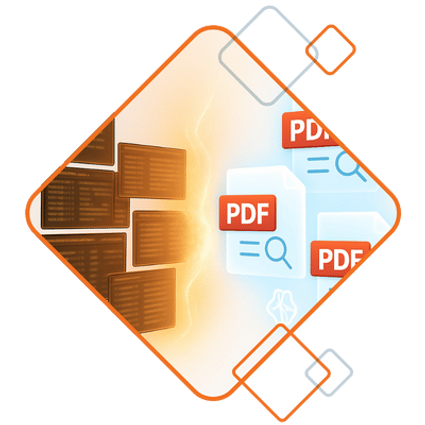
What M&A Snapshot Does
M&A Snapshot preserves an acquired or divested application environment in its operational form at the moment of transaction. This extends well beyond raw data extraction. The process captures:
-
Screens and reports as they were presented to users.
-
Documents and associated records.
-
Relationships between data objects.
-
Embedded audit trails and compliance context.
-
The structure that governed how the system functioned.
The result is a structured, human- and machine-readable archive that reflects the system exactly as it operated on the day it was retired.
There is no reinterpretation of historical logic. There is no dependency on the target platform. The integrity of the original environment is preserved.
This enables ownership change without knowledge loss.

A Governance Instrument for Transaction Events
System Transition Governance recognizes that system change is not only a technical event — it is a governance event.
M&A Snapshot formalizes that moment.
It ensures that:
-
Compliance frameworks remain intact during integration
-
Audit defensibility is preserved during ownership change
-
Operational continuity is maintained while infrastructure evolves
-
Historical records remain legally defensible after consolidation
In acquisitions, this protects the acquiring organization. In divestitures, this protects the divested entity. In both cases, it removes the pressure to rush system consolidation simply to eliminate infrastructure cost.

When M&A Snapshot Is the Right Instrument
M&A Snapshot is deployed during defined transition events where system ownership changes. Common scenarios include:
Post-Acquisition
Integration
When immediate operational alignment is required but long-term platform decisions are still being evaluated.
Regulated Industry
Transactions
Where financial services, healthcare, insurance, or public sector organizations must maintain uninterrupted compliance throughout integration.
Divestiture
Preparation
When business units must be separated cleanly while preserving defensible historical records.
System Consolidation
Following Transaction
When duplicate ERP , case management, policy administration, or mainframe environments need to be rationalized without sacrificing historical integrity.
How M&A Snapshot Works
M&A Snapshot follows a structured methodology designed to protect continuity during ownership change.
The infrastructure is removed.
The knowledge remains accessible and defensible.

Comprehensive
Transaction Capture
The acquired or divested system is preserved in its operational state, including screens, reports, data objects, documents, and relational structures.
.png)
Tamper-Evident
Conversion
Captured content is converted into digitally signed, tamper- evident PDF structures enriched with metadata and audit integrity controls.

Controlled Infrastructure
Rationalization
Once the snapshot is validated and accessible, transitional infrastructure can be retired or consolidated without loss of institutional knowledge or compliance continuity.
Built for Compliance and Legal Defensibility
Transaction events increase regulatory scrutiny.
M&A Snapshot employs tamper-evident PDF technology designed to support:
-
Digital signatures that prevent alteration.
-
Embedded audit trails.
-
Long-term immutability.
-
Legally defensible retention practices.
Unlike traditional migration projects — which transform and reinterpret data — M&A Snapshot preserves the system as a complete historical artifact.
This distinction matters because regulators, auditors, and legal reviewers often require visibility into how the system functioned — not simply what data it contained.

Accessible to Business Users and AI Systems
Snapshots remain fully searchable and accessible without dependency on the original application. Business users can retrieve historical information through intuitive interfaces, while structured metadata supports analytics and AI initiatives.
By preserving machine-readable structure alongside human-readable presentation, Legacy Snapshot ensures that historical knowledge remains usable rather than dormant.
M&A Snapshot addresses system end-of-life governance within the broader Sunset Point platform.
It operates alongside:
-
Historical Snapshots for retired systems
-
Live Snapshot for real-time system visibility
-
AI Insights for structured knowledge extraction
-
Governance dashboards that provide system estate perspective
By preserving both presentation and machine-readable structure, M&A Snapshot ensures that transactional knowledge remains usable rather than dormant.

Frequently Asked Questions
Q: How is M&A Snapshot different from traditional system integration?
A: Traditional integration transforms and migrates data into a new platform structure, often introducing interpretation risk and operational dependency.
M&A Snapshot does not migrate data.
It preserves the acquired system’s information structure exactly as it existed at the moment of transition, enabling consolidation without historical distortion.
Q: How does M&A Snapshot support regulatory
compliance during a transaction?
A: The snapshot preserves embedded audit trails, system logic, and compliance context in tamper-evident form.
This ensures continuity of defensibility throughout ownership transition and infrastructure consolidation.
Q: What happens to customer data and historical records after consolidation?
Q: Can acquired teams continue operating during integration?
A: In a word, yes.
Snapshots are created without disrupting ongoing operations. Once preserved, historical information remains accessible while integration decisions are made on your timeline.
A: Customer relationships, historical records, and compliance artifacts remain accessible through the preserved snapshot, even after original infrastructure is retired.
There is no loss of operational context.