
The AI Blind Spot: Why Legacy Systems Are Blocking Your Enterprise AI Strategy
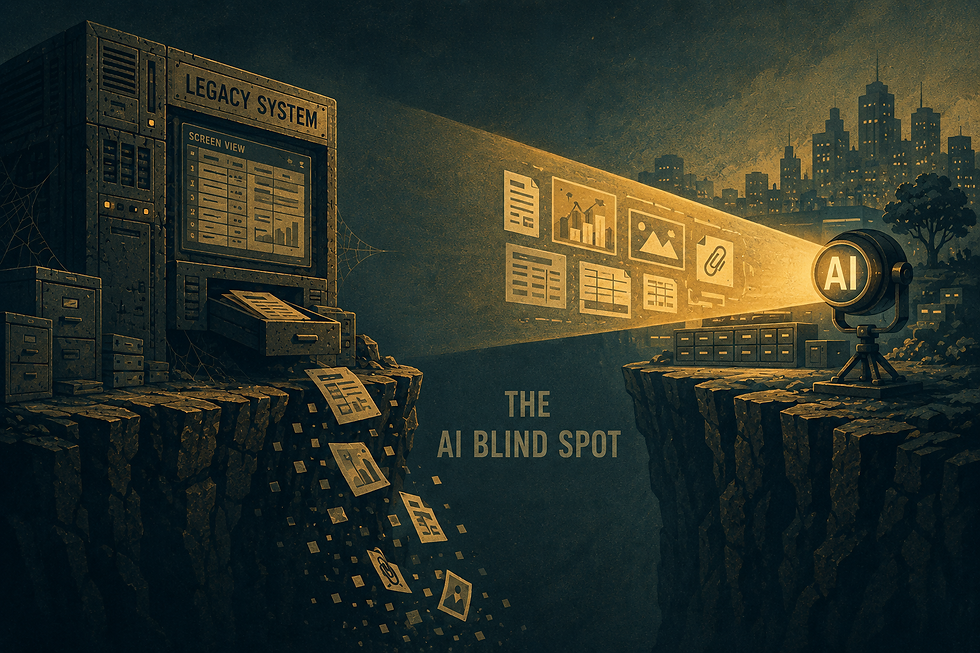
Most AI roadmaps assume the hard part is choosing the right model or the right vendor. Talk to the people actually trying to ship agentic AI inside a large enterprise, and a different story comes up almost every time. The model is not the bottleneck. The data is, and a lot of the data that matters most is sitting inside systems the enterprise has been trying to retire for years. Deloitte found that nearly 60 percent of AI leaders cite integrating legacy systems as their organization's primary challenge in adopting agentic AI, ahead of risk and compliance concerns. The systems enterprises most want to shut down are the same ones their AI strategy cannot function without.
That collision creates what we call the AI blind spot: information that existed and was usable inside a legacy system's screens, reports, and attachments becomes structurally invisible to any AI tool the moment that system goes dark. This post makes the case that the blind spot is not a future risk to plan around. It is created at the exact moment IT teams think the retirement project is finished.
What the AI Blind Spot Actually Means for Legacy System Data
The AI blind spot is easy to misdiagnose as a migration problem, something a bigger export job or a longer project timeline would fix. It is not. It is a format problem. Modern AI tools work well against structured, indexed, machine-readable content. A pre-AI legacy system was never built with that in mind. Its most valuable information often lives in places a database export does not reach: a scrolling report only visible through the application's own UI, a scanned attachment sitting behind a login screen, a screen layout that gave a raw field meaning because of where it sat relative to three other fields on the same page. None of that context survives a raw data dump. It survives only if someone captures it deliberately, in a form an AI tool can actually query.
Why Bulk Data Export Cannot Solve the AI Blind Spot in Legacy Systems
The instinct when a system is scheduled for retirement is to export everything and worry about the details later. That instinct is exactly what creates the blind spot rather than closing it.
A flat export captures rows and columns. It does not capture the narrative relationship between a customer record and the five attachments referenced inside it, or the reason a particular field was flagged, which existed only as a comment typed into a screen that the export never touched. Once that context is gone, an AI tool querying the exported data cannot answer the questions that actually matter. It can tell you a value. It cannot tell you what that value meant, because the meaning was never structured data to begin with. It was UI context, and UI context does not survive a bulk export.
How Legacy System Decommissioning Makes the AI Blind Spot Permanent
The blind spot is recoverable right up until the day the legacy system is actually shut down. After that, it is not.
Once the source system is gone, there is no going back in to recapture a report that was never pulled, an attachment that was never downloaded, or a screen relationship that was never documented. Whatever was preserved before shutdown is what an AI tool will ever have access to. This is the part IT teams tend to miss. The decommissioning project is usually judged a success the day the legacy system goes dark. That is also the exact day the AI blind spot, if one exists, becomes unfixable rather than merely inconvenient.
What AI Readiness Actually Requires From Legacy System Data
Closing the blind spot requires treating AI readiness as part of the capture work itself, not something addressed after the fact. That means structured capture at the point of retirement: field values, screenshots, reports, and attachments gathered together and organized into a coherent, schema-conformant record while the legacy system is still running and still capable of producing that context.
Done this way, the resulting record is not a static archive waiting to be reprocessed someday. It is already in a form an AI tool can search, retrieve, and reason over directly, with the same screen relationships and narrative context intact that made the original data useful in the first place.
Closing the AI Blind Spot Before Legacy System Retirement Locks It In
Nearly 60 percent of AI leaders are already running into legacy systems as their biggest obstacle to agentic AI, and every legacy system still awaiting retirement is a decision point rather than a foregone conclusion. Retire it with a bulk export and the blind spot closes over permanently the day the system goes dark. Retire it with AI-usable capture built in from the start, and the same shutdown that resolves the technical debt also resolves the blind spot, instead of creating a second, unfixable version of it.
Learn how Sunset Point approaches system transition governance at sunsetpointsoftware.com.